
Tag: clare county

  • 1.8 Million Years of Clare History (or 150 feet)

    Note: This is the first of two posts dealing with the geologic history of Clare County, Michigan, USA.
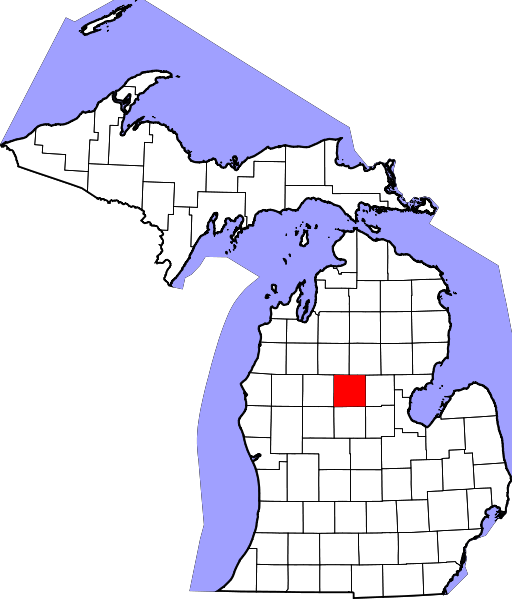
    Map showing where Clare County is in Michigan

    Ever take a good look at our county?  Its rolling landscape, many bodies of water (20 Lakes in 20 Minutes), numerous gravel and sand pits, the fact that the south end of the county is hundreds of feet lower than the north end.  Ever wonder why it looks the way it does? Why it has so many rocks? So many lakes? And oil?

    It’s a fascinating story.

    What we now call Clare County has been around for more than 4 billion years and has physically traveled a long way and has seen volcanos and oceans.  Only recently–in the last 11,000 years of so–has it been in the form we now know it.  If you think of time as a yardstick*–a really long yardstick in this example–with every 1,000 years being an inch and us at one end, Clare County has existed in its present form for about 11 inches, while the land far underneath and around has been in existence for about 66 miles or so. As I said, a really long yardstick. But more on that later.

    And while the land has been around for more than 4 billion years, you won’t find any dinosaur bones. Now there is always a remote chance you will find the remains of a mastodon and woolly mammoth in the county (a tooth most likely since those tend to survive because they don’t decay as easily, no pun intended), any traces of dinosaurs were scrubbed way by glaciers and/or buried several thousand feet and under tons and tons (and tons) of glacial till, which is debris from a glacier.
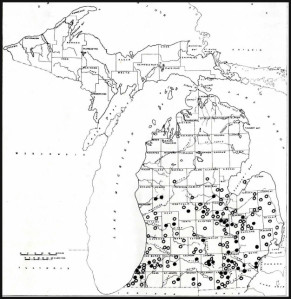
    Circles indicate where the remains of a mastodon were found. Most discoveries have been where swamps once existed. The theory is that the animals may have fallen through a mat of vegetation trying to feed, were quickly swallowed by mud and were preserved.

    If you do find a mastodon or mammoth (and it more likely to be the former since they have been found in Michigan more often), yours will be the first. That’s because while mastodon fossils have been found in most surrounding counties and mammoth fossils in a few counties, neither has been found in this county. And yes, there is a difference between the two herbivores but no, they are not dinosaurs. Real dinosaurs like your t-rex and triceratops have been extinct for hundreds of millions of years (3 miles on our yardstick), while these elephant-sized, mammals (the largest that we know of in our state) last trod our mitten-shaped peninsula 6,000 to 8,000 years ago (6-8 yardstick inches away), according to scientists who study that kind of stuff.

    I learned this from a paper by Margaret Anne Skeels of The University of Michigan, entitled The Mastodons and Mammoths of Michigan, presented back in 1961. And if a mammoth or mastodon remain has been found in the last 54 years, I can’t find evidence of the discovery.

    Ms Skeels also wrote that we don’t really know why these critters became extinct, but that it was most likely due to a warming climate.  The same warming that caused the glaciers to retreat to the arctic. While there is evidence that Indians of the Southwest hunted mastodons, we have no evidence that Indians in our state hunted them or were at all responsible for their extinction.
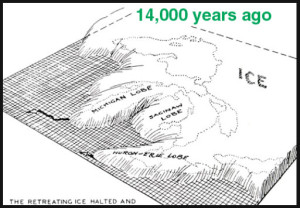
    The retreat of last of the four glaciers that covered Clare County. Each glacier sculpted our county and dropped tons of sediment (glacial till), in its wake.

    However, let me rewind a bit and talk more about glaciers and ice ages.  I will cover our really distant past (oceans, the equator, formation of oil deposits and more) in Part 2.

    Scientists believe there were at least four glaciers that covered all of Michigan and much of North America over many hundreds of thousands of years, complete with warm periods in-between when the glaciers receded. These ice ages and resulting glaciers were known as the Nebraskan, Kansan, Illinoisan, and the Wisconsinan. Why the earth cooled enough that glaciers from the arctic region expanded to cover all of Michigan and a good part of North America is unknown but it may have to do with long-term variations in the orbit of the earth (Milankovitch Cycles).

    And whether we are currently in one of the those “in-between periods” is also unknown; however, it is known that  starting about 1.8 million years ago (150 feet away on our yardstick), at the start of what is known as the Quaternary period, it got cold and it stayed cold and that ice sheets covered all 83 Michigan counties including ours.  The height of those glaciers has been is estimated to be 10,000 feet or more, and the tremendous weight and pressure of the ice compressed the earth as it gouged and shaped the landscape.

    While these  glaciers advanced, they captured and transported with it everything in its path from huge boulders to rocks, stones and gravel. That means many of the rocks you see or that farmers have to contend with when they plow, may have come from hundreds of miles to the north where it was transported by the final glacier.

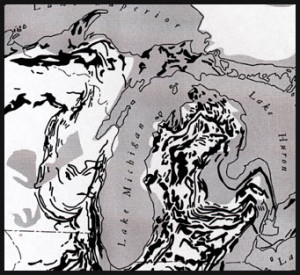
    Black lines show the many moraines in our state. The Saginaw Bay region is without moraines because it was until relatively recently (geologically speaking) under water and its moraines have been eroded by wave action or low areas filled in with sand and debris.

    The glaciers’ movements weren’t constant and the advances and retreats occurred over 10s of thousands of years (the last glacial age lasted more than 100,000 years). When the Wisconsinan glacier finally retreat for the last time–which means the glacier was melting faster than it was advancing–all the geologic junk contained in the ice was dropped in irregular piles, creating the landscape we now see. Where the glacier was in one place for a longer period of time (decades perhaps) hilly areas developed called moraines.

    There are many moraines in Michigan and one rather large one divides our county roughly in half. Its southernmost boundary is quite visible as one drives on Old-27 near Adams Road with James Hill as one of the landmarks (see photo below).  In this general area the Saginaw lob of that final glacier rubbed up against the Lake Michigan lobe with both dropping glacial till in the form of rocks, sand and gravel, and gushing huge quantities of meltwater. To the south of the moraine and several hundred feet lower in elevation are Clare and Farwell. Atop the moraine are the communities of Harrison, Temple and Leota.  There is more to the story than just a difference in elevation. The soils are different with that to the south being less sandy and more fertile (see Soil story below).
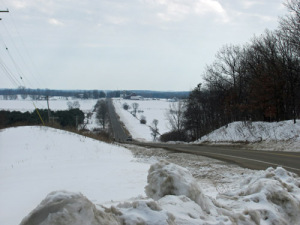
    View looking south atop the glacial moraine at James Hill (Adams and Old 27).

    Our lakes were included in the glacial formation, both the Great Lakes and our inland lands.  Many of the inland lakes were the result of great blocks of ice being dropped by the glacier, then being buried under tremendous amount of debris left by ice. Once the glaciers melted, the ice blocks too slowly melted under the glacial till leaving depressions filled with water in their wake.  How big were the ice blocks? Well, think Houghton Lake and closer to home, Budd Lake.

    The glacial till is thick. According to S. G.Berquist, in his The Glacial History and Development of Michigan, the average depth of glacial deposits over the bedrock in the state is 300 feet. In other places, like in the western end of the Upper Peninsula, the bedrock remains visible and minerals such as iron and copper can be found because the glacier was not powerful enough to erode them.

    Because the till left by the glacier are mixed, the deposits in many areas of our state are unstratified, that is mixed and lacking in layers. However, because the vast amount of meltwater issuing from the retreating glaciers carried sediment with it as it flowed, that water often sorted the till into various sizes such as cobble, gravel, pebble, sand, silt and clay, according to Berquist. That’s why we find sand pits, gravel pits and the like in our county and around our state.

    So, the next time you take a drive or a walk, look around you and marvel at what God, nature and time has wrought.  Then pick up a rock and look at it carefully and take time to appreciate it.  After all, it traveled a long way to get to you.
    cartoon

    (Writer’s Note: Please let me know if any of my information is not clear or in error. I like geology and wanted to keep this brief and easy to read but I also want it accurate.)

    Want to learn more about Michigan’s glaciers? Here are some resources:

    * The yardstick idea comes from Geologic  Time Line Helper on the Dept. of Environmental Quality website. (www.michigan.gov/documents/deq/GIMDL-GTLH-GEN_307780_7.pdf)

    MORE ON CLARE COUNTY’S SOIL

    The book the Soil Survey of Clare County, Michigan, published by the United States Dept. of Agriculture’s Soil Conservation Service (1978) graphically illustrates the soil types found in the county. Below is a map of the county and accompanying legend.
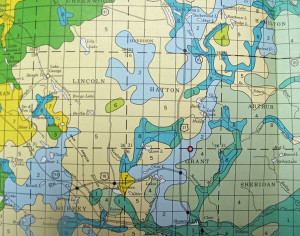
    Colors show the various soil types found in the county. The soil to the south is more fertile owing to the fact the land below the glacier moraine was underwater following the glacier and gained additional nutrients. The red circle at the center shows the general location of James Hill.

    The approximate location of the glacial moraine (running northeast to southwest) can be discerned in the map below in the soil shown in yellow.  The legend descriptions of the soils in the northern section of the county generally include sandy in their definitions, while the soil to the south (designated by a 4) does not include that term.  Soil to the south of the moraine is generally more fertile.  One reason is that the lower elevations to the south were under water for an extended period of time when the glaciers receded due to the elevated levels of the Great Lakes and the forerunner to Saginaw Bay.

    soil survey map with the county's various soil types

  • 2.5 Billion Years of Clare History (or 40 Miles)

    Note: This is the second of two posts dealing with the geologic history of Clare County, Michigan, USA.

    If you like warm, you should have lived in Clare County, Michigan about 360 million years ago (about 5.6 miles away on our long yardstick in which 1,000 years equals 1 inch and we are at one end). Back then, our county (all of North America as a matter of fact), was nearer to the equator. That’s when the continents were one big happy lump and before the tectonic plates, including the one on which we ride separated, with ours moving slowly but steadily north until it arrived at its present location. It’s still moving and will probably be someplace even colder in the future, but don’t run out and buy a new coat just yet. You may not need it for another 360 million years.

    This stair-step chart shows the various eras of time with Precambian (purple) representing the greatest stretch of time (4.6 billion to 570 million years). The sediments that underlay our county were laid down during the Paleozoic era (red). The dinosaur era doesn’t really get started until the Triassic era at about 245 million years ago (green). We’re in the yellow era.

    As to our county, it wasn’t in its present condition when it did arrive here. That’s because the glaciers that shaped it and put down all the debris (glacial till) that formed our hills, valleys, plains and such were still far in the future (see Part 1 of this blog post).

    However, we were in a valley back then, well it was—and is—more of a basin and it bears the name the “Michigan Basin.” We lie near the middle of the basin and the bedrock that is the underlying formation, is nearly 16,000 feet below us. The basin is deepest in the middle of our state and then gradually tilts upward the surface forming a rim. The basin covers an area of about 119,000 square miles and is visible in various areas including parts of the western Upper Peninsula.  The bedrock, which forms the basin, is made of igneous rock meaning that it was molten at one time.  The formation of the Michigan Basin goes back about 2.5 billion years (or 40 miles on our really long yardstick) when geologic pressures deep underground caused the rock to be twisted into its present shape.

    Types of bedrock in Michigan. The Michigan Basin is clearly visible.

    There is not 16,000 feet of glacial till between us and the bedrock though.  That’s because many times in the distant past–long before the glaciers–Clare County was under water. Salt water and lots of times. According to an article from Michigan State University on the Michigan Basin, inland seas covered Michigan during what was termed the Devonian period, a period of about 60 million years that started about 450 million years ago (that’s only 7 miles away on our yardstick). The Devonian period was pre-dinosaur, by the way with most of earth’s creatures living in the oceans (although there were spiders, millipedes and insects scurrying about on the land, which might explain why the ocean’s inhabitants were slow to move out of the water and up onto the land).

    At times the seas were clear supporting a variety of shellfish; at other times the seas were muddy with great quantities of silt and decaying vegetation. At other times, the seas contained minerals or were more like huge swamps.

    The sediments of each sea compacted to rock (sedimentary). As each layer of sediment was laid down, the basin became shallower. Such things as Clare County oil fields and Saginaw County coal and salt mines, and Alpena County’s limestone quarries, are testament to those ancient seas and the sediment they left behind. Core samples taking during drilling is one way we’ve learned what lies beneath.

    The various layers of sediment with the names corresponding to the stair-step chart above.

    The glaciers wiped out any record of the dinosaurs. Our records kind of ends with the Pennsylanian era, although, as the graphic at left shows, we do have a few areas of Jurassic rocks. But no dinosaurs.

    There are other fossils, though.  Petoskey stones, which are fossilized coral, are the most widely known and are the official Michigan State Fossil. Although we don’t have an abundance of these fossils in our county, the glaciers did drop some in their wake.  There are also a large number of others from the Devonian seas that can be found. These include both plants and marine animals, with the latter including clams, corals, crinoids, trilobites, fish and more. (An interesting day can be spent around a quarry or roadside just what the glaciers dropped.  There is almost always an assortment of beautiful stones and interesting fossils to be found–if one looks close enough.  Be courteous of private property, however.)

    There’s also traces of gold and silver in Clare County.  Sorry, no veins of gold, just trace amounts that were scoured off gold-bearing rocks in Canada and maybe the Upper Peninsula and dropped here. Of course, there’s always the chance that the glaciers dropped some golf ball-sized nugget somewhere in the county just waiting to be discovered. We can only hope.

    Oh, one more thing, among the rocks in Clare County there might be a meteorite or two. None has ever been reported in this county, but one was found two were found not too far away. One in Reed City found in 1895 and one in Kalkaska in the late 1940s. Both found by farmers working their fields.

    cartoon2

    So, keep your eyes peeled. You never know what cool things this county has in store just waiting to be discovered.

    (Writer’s Note: Please let me know if any of my information is not clear or in error. I like geology and wanted to keep this brief and easy to read but I also want it correct.)

  • A Face to a Name in a Graveyard

    Jim Garrity went off to war.

    Garrity family _Eyers

    Jim was a farm kid from rural Clare County, Michigan, a poor, sparsely populated county in mid Michigan. According to family history, Jim enlisted in the navy in Nov. 1917 joining his cousin Arthur Looker at the Naval Training Academy in Illinois.

    Jim Garrity went off to war but never saw combat. He died barely two months later while in training of the Spanish flu, a pandemic that would kill an estimated 50 million to 100 million worldwide before disappearing. Many of the flu’s victims were young men, like Jim—and like Arthur who also died of the deadly virus one week earlier.

    So instead of coming home proud veterans, Jim and Arthur came home in wooden boxes. Jim was buried in his family’s small cemetery on a knoll in Hamilton Township. Arthur was buried in Gladwin cemetery.

    2013_August_Harrison_Gerrity Cemetery2

    So two sisters grieved their two sons. It was a tragic bond they now held with a third sister who had also lost her son from the flu the year before. Ervin Reed had been at Fort Wayne near Detroit. Reed too is buried in the small Garrity Cemetery.

    Last year, Jim Garrity, Arthur Looker and Ervin Reed were just names. They became the subject of a blog post because I wanted to tell the story of their brief lives.  That post caught the attention of Marianne Eyer, a direct descendant of the Garrity’s, who lives in Marquette, Mich. She shared a photo of Jim; and suddenly a name I knew only in a graveyard had a face.

    newsletter James

    A handsome face. The nearly century old photo of Jim is badly faded but shows a young broad-shouldered young man staring confidently into the camera.

    We don’t know exactly why Jim Garrity went off to war, but according to Marianne, the story is that Jim was the only son in a farm household with four sisters. His father would not let him join the service so Jim convinced his mother to let him go. Perhaps the lure of far off places, the excitement of war despite its dangers, trumped life on the farm.

    Did Jim’s father ever forgive his wife because she gave their only son her blessing to join the Navy? One wonders, after Jim died, whether his mother blamed herself because she did allow him to go.

    Family history also says Jim’s sister Hazel insisted Jim be given his high school diploma, although even at 20 he had not graduated. He was smart, his report card from 1916 shows that fact; he just didn’t like school—and maybe farming. Maybe he felt he was destined for bigger things than tilling the soil. We will never know.

    Newsletter - grave

    Because Jim Garrity went off to war.

  • Blowing Stuff Up in Clare County

    The following article appeared on Page one of the Dec. 4, 1925 issue of The Clare Sentinel .   Apparently, farmers back then could be trusted with dynamite.  However, as the note at the end of the article reveals, there was a dark side and some people used it for the wrong reasons, even back then.

    Explosives

    DO FARMERS WANT EXPLOSIVE?

    Orders Must be Placed Now for 5,000 Pounds to Complete Car.

    Some few weeks ago it was learned from the Extension Department of the Michigan State College at Lansing that it would be possible for Clare county to obtain from the U. S. Government another car of the now- famous war-explosive “Pyrotol.”

    A minimum car load is 20,000 pounds. Up to date orders have been placed for 15,000 pounds. Orders must be placed for the additional 5,000 pounds, before it will be possible to obtain the carload allotment. It has been stated that this will be the last opportunity for Clare county to obtain a carload of the explosive. While it is said that “Pyrotol” is more powerful than the strongest dynamite the price is only approximately one-third that of the latter explosive, Costing the farmer 9 1-2 cents per pound delivered at Clare; arid also while the supply lasts, there will be 100 caps given free with every two hundred pounds of “Pyrotol.”

    Orders are being taken at the Citizens State Bank, or at the office of The Clare Realty Co. It is hoped that sufficient orders may be obtained within the; next few days to enable Mr. Bicknell to have car shipped this month.

    If you have any stumps or boulders to blast, or have any need whatsoever for a powerful, reasonably-priced explosive now is the time to order.

    Farmers residing in counties adjoining Clare are not barred from getting in on this and the price to them will be exactly the same.

    ***

    Note:  According to Wikipedia, pyrotol was an explosive available for a time after World War I. It was reprocessed from military surplus.  Usually used in combination with dynamite, it created an incendiary blast. Since it was very inexpensive, it was often used by farmers to remove tree stumps and clear ditches.  The substance was known for being used to commit the Bath School bombing in 1927 and distribution of pyrotol for farm use was discontinued in 1928 due to exhaustion of the supply of surplus explosives.

  • The Great Flu Pandemic in a Small Michigan County

    The Great Flu Pandemic in a Small Michigan County

    Jim GarrityB&W-small
    James Garrity in an undated photo.

    James Garrity was a Clare County farm boy, the only boy in a family of four sisters.  He was 19 years old when he convinced his mother, over the objections of his father, to join the Navy.  James  wanted to join his cousin, Arthur Looker, a Gladwin county resident, who had just joined the Navy.  That was in Nov. 1917.  In Jan. 1918, Arthur died of the flu at the Great Lakes Naval Training Station in Illinois.  Jim Garrity died the next day.  Both men were brought home by train for burial.  Jim’s obituary described him as bright and cheery with a host of friends.  It added that he was to have graduated from Harrison High School the following June.

    Their deaths occurred before what is no called “the Great Flu Pandemic” had even gotten started.  Peaking in the winter of 1918, this worldwide event would  sicken more than a half a billion people, killing between 21 million and 100 million of them.  In the U.S., about 28% of the population (then at 105 million) became infected, and 500,000 to 675,000 died.  Deaths were especially high in young men, the group that included soldiers like Garrity and Looker.  The flu became pneumonia and the buildup of fluid in their lungs, something Covid-19 does now, is what ultimately caused death.  However, with this particular flu strain, it was those with the strongest immune systems who were especially vulnerable.  As a result an estimated 43,000 American servicemen died, more than were killed by German bullets.  Roughly 1 in 4 military personnel came down with the virus, and of those who did, 1 in 5 died.  Death often came quickly, sometimes even within hours of the first symptoms. Congestion brought on by the flu built up quickly in lungs, resulting in pneumonia, which was the cause put on many death certificates of that period.

    The Dec. 5, 1918 issue of The Clare Sentinel contained an article about Earl Green, a sailor from the small Clare community of Mann Siding, who told of how, while stationed in Boston, “he helped roll up 200 boys [soldiers] in sheets and carry them out onto the docks to be buried.”

    Garrity was not the only Clare County resident killed by the flu. In total, 22 out of Clare’s 450 soldiers and sailors died from the flu, according to local historian Forrest Meek, author of Michigan’s Heartland, a history of Clare County from 1900 to 1918. Meek also writes that at least 59 county deaths were directly related to the flu (see listing from the book at end of this article). Clare County had only about 8,300 people at the time.

    The Clare Sentinel during that period is filled with mentions of families and individuals coming down with the flu, battling the flu, recovering from the flu, or dying of it.  There were also numerous mentions of church and school closures, sometimes for weeks at a time.

    cough small

    Public Service Announcement from October 24, 1918

    Public service announcements warned of the dangers of coughing and sneezing in public and advertisements hawked products to those stuck indoors .  In Michigan’s Heartland, Meek writes that doctors of the community worked overtime during the outbreak.  Meek said that Dr. William Clute of Clare, hardly left his car for days.  He had a chauffeur who took him on his calls and “those few moments constituted his night’s quota of slumber.”  Meek wonders whether the fact Dr. Clute died at age 53 was partially due to his having worked so long and hard during this epidemic.  

    victrola small

    Advertisement in The Clare Sentinel from Nov. 14, 1918

    Unlike now, there wasn’t a shelter in place requirement but then there wasn’t much of a need.  Clare County was not a vacation destination at that time, there were no freeways and few good roads of any kind.  Although people could travel by train within a state and across the country, travel internationally, other than war related travel, was rare.  It was not  until after the Second World War that regular international flights began to take place.  During WWI, that meant what happened in China and other countries, including health problems, tended to stay in those countries. Of course, soldiers returning from foreign battlefields and lands could carry diseases back with them.  But eventually the flu disappeared and Clare County, Michigan, and the world returned to normal.

    James Garrity was buried in a small cemetery in Hamilton Township.  A marker and an American flag mark his grave.  His is a story more than a century old, but also a story that’s still relevant today.Deaths small

    Listing of flu deaths as compiled by Forrest Meek in his book, Michigan’s Heartland

  • Gangsters Up North

    A review of Robert Knapp’s latest book on Michigan history

    Yes, Al Capone DID visit Michigan. Just not a whole lot.

    I want to know more about Joe Barnes. Was this resident of Clare County that author Robert Knapp talks about in his new book Gangsters Up North, Mobsters, Mafia and Racketeers in Michigan’s Vacationlands REALLY Al Capone’s chauffeur as he sometimes claimed to be? And did Barnes host Capone’s men at his Arthur Township property as has been alleged? Was Barnes really a gangster like so many others who came to Clare, men like Meyer Lansky, the Purple Gang’s Bernstein brothers, and sorta gangsters like Sam Garfield, Harry Bennett and Isaiah Leebove. I really want to know.

    Robert Knapp

    In this book, Knapp offers compelling evidence that Barnes was a gangster connected with Capone but stops short of confirming it. However, Barnes is just one many fascinating characters we meet. Knapp has unearthed plenty of stories as well as rumors about nationally known, honest-to-goodness gangsters in Northern Michigan, men such as John Dillinger, Baby Face Nelson and Fred “Killer” Burke. The book also covers lesser known ones. In fact, it appears nearly every good size city in the Northern Lower and Upper Peninsulas had gangsters living there or at least visiting. It was amusing to learn how rumors have grown over time. For example, if a gangster did own a home, that home invariably had, according to locals, machine gun nests, guards, and secret tunnels (like the ones Henry Ford’s enforcer Harry Bennett supposedly had on his property in western Clare County). 

    Clare County is well represented. While I won’t go as far as to say Clare, Michigan was Michigan’s “Gangster Central,” it did have more than its fair share of mobsters, as we learned in Knapp’s other books, Mystery Man about Isaiah Leebove, and Minion of the Mob about Sam Garfield. However, that said, neither Capone or Dillinger ever visited Clare.  However, Big Al’s little sister did live in Oscoda, Michigan for many years, and kept a photo of Al on her nightstand. She was Knapp reports, “a lifelong apologist for the family.”  

    The story of Capone’s sister is only one of many things I learned from reading this book. I also learned how widespread gambling was and how many gangsters were involved. Even the Grand Hotel on Mackinac Island offered gambling as a profitable although illegal pastime for its guests. It was also interesting to see how many cities and towns in Michigan had connections with gangsters. Even more interesting is to see the huge number that now claim to have had them!  

    Of course, gangsters didn’t come to Michigan just to engage in illegal activities or hide out. They also came for the same reason people come now—to relax and enjoy the beauty this state has to offer and Knapp covers that topic as well. Oh, although Knapp doesn’t say it, there is absolutely NO evidence any gangster even came to Clare for its baked goods, not matter how good those sugary treats might be. 

    Like Knapp’s other books, Gangsters Up North is well researched and an easy read. Although it deals with a serious topic, there is even a story in it about a gangster’s kidnapping that will make you smile if not laugh out loud. Gangsters Up North is currently available online and locally in Clare County

    BTW, if you have the real scoop on Joe Barnes, let me know. Please don’t make me send a gangster or mob enforcer after you.

    Note: Knapp is also the author of several other books on Clare County’s history and it’s association with gangsters. They are:

    • Minion of the Mob, Sam Garfield’s Two Lives
    • Mystery Man, Gangsters, Oil and Murder in Michigan (Isaiah Leebove)
    • Clare, Michigan, 1865-1940 (Images of America Series)
  • Clare County Murders 1871-2020

    A review of a book by Jon H. Ringelberg

    Thou shalt not kill: Exodus 20:13

    It’s one of the 10 Commandments and even people who don’t read the Bible know of that one. Sadly, it’s also a commandment that has been broken since the dawn of time (like so many other commandments).

    A new book by local historian, attorney, and former District Court Judge Jon H. Ringelberg shows that that this specific commandment has been broken in Clare County at least 69 times going back to 1877, not long after the county was founded, and that doesn’t even mention poor Rover, whose story is also covered within the book’s 222 pages. Appropriately titled Clare County Murders 1871-2020, large paperback book details every recorded manner of death that occurred within the county’s  borders including the who, what, when, where and why, and of course, the how (as one might imagine guns are the most frequent method but the reader learns of the other imaginative ways Clareites have found to eliminate those they despised).

    Along the way the reader meets men like Owen Feeney whose death led to the naming of Deadman’s Lake near Farwell; a 12-year-old girl who killed a younger sibling due to jealousy; and a case in 1903 that could have been right out of a current episode of CSI as it includes a exhumation of a body to prove poisoning.

    Of course, the most well-known murder in the County, that of Isaiah Leebove at the Doherty Hotel in 1938, is included, although Ringelberg gives readers just a summary of that murder, directing readers instead to the book Mystery Man, a biography of Leebove by Robert Knapp.

    One of the interesting items that Ringelberg includes in his book is a look at what he calls the “speed of justice,” over last 150 years. He might of more accurately called it the “lack of speed of justice,” since the amount of time has more than doubled in most cases.

    Oh, and if you’re wondering, murders have occurred in all but one county township: Hats off to you Summerfield. One more thing, be extra nice to people in the middle of August, that’s the month with the most murders and Ringelberg adds that most murders seem to happen in the middle of the month. Not sure what to make of all that, but it may be worth keeping in mind when the dog days of summer roll around next year.

    Clare County Murders is available at Cops & Doughnuts in Clare, the Clare County Cleaver office in Harrison and through Amazon. Let’s just hope there’s no need for a revised edition of the book with even more murders, but with human nature being what it is that may be wishful thinking.